Fialkora MyndruUkrainian Clinical & Rehabilitation Psychologist
Clinical observations from interdisciplinary practice in wartime Ukraine

CARE UNDER FIRE

Rethinking Mental Health in Conditions of Chronic Threat

Behavior must be interpreted in context, not in isolation.

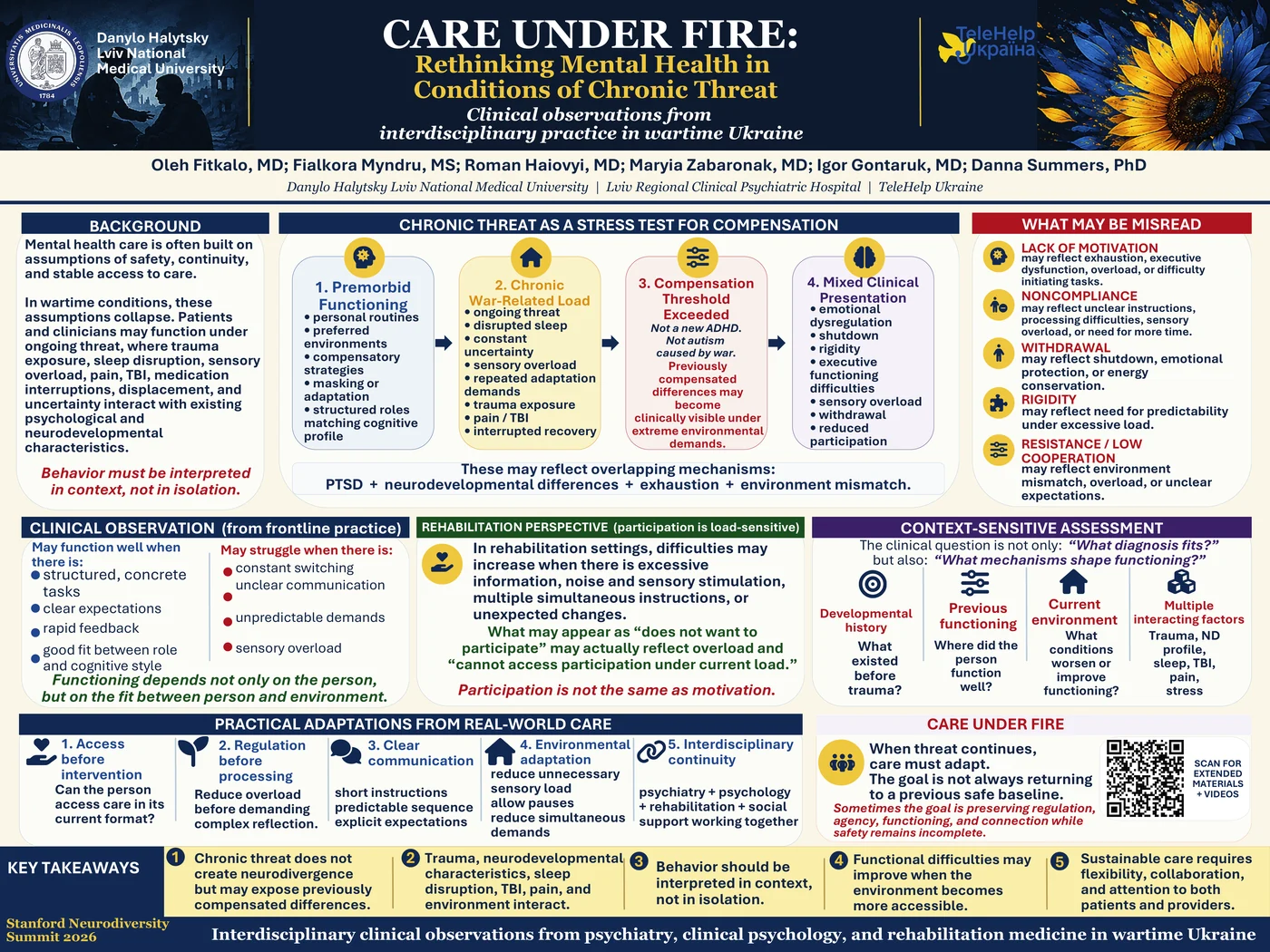
Interdisciplinary clinical observations from psychiatry, clinical psychology, and rehabilitation medicine in wartime Ukraine.

Care Under Fire poster presented at Stanford Neurodiversity Summit 2026

Poster presented at Stanford Neurodiversity Summit 2026. Select the image to open the PDF.

Why this project matters

Mental health care assumptions change when threat is ongoing

Mental health care is often built on assumptions of safety, continuity, and stable access to care. In wartime conditions, these assumptions collapse. Patients and clinicians may function under ongoing threat, where trauma exposure, disrupted sleep, sensory overload, pain, TBI, medication interruptions, displacement, and uncertainty interact with existing psychological and neurodevelopmental characteristics.

Behavior must be interpreted in context, not in isolation.
Chronic threat as a stress test for compensation

Four connected stages

1

Premorbid Functioning

Personal routines, preferred environments, compensatory strategies, masking or adaptation, and structured roles matching cognitive profile.

2

Chronic War-Related Load

Ongoing threat, disrupted sleep, constant uncertainty, sensory overload, repeated adaptation demands, trauma exposure, pain / TBI, and interrupted recovery.

3

Compensation Threshold Exceeded

Previously compensated differences may become clinically visible under extreme environmental demands.

Not a new ADHD.
Not autism caused by war.
4

Mixed Clinical Presentation

Emotional dysregulation, shutdown, rigidity, executive functioning difficulties, sensory overload, withdrawal, and reduced participation.

PTSD + neurodevelopmental differences + exhaustion + environment mismatchThese may reflect overlapping mechanisms rather than one single explanation.
What may be misread

Observe function and context before moralizing behavior

Lack of motivation

may reflect exhaustion, executive dysfunction, overload, or difficulty initiating tasks.

Noncompliance

may reflect unclear instructions, processing difficulties, sensory overload, or need for more time.

Withdrawal

may reflect shutdown, emotional protection, or energy conservation.

Rigidity

may reflect need for predictability under excessive load.

Resistance / low cooperation

may reflect environment mismatch, overload, or unclear expectations.

Functioning depends on fit

Functioning depends not only on the person, but on the fit between person and environment.

May function well when there is:

  • structured, concrete tasks
  • clear expectations
  • rapid feedback
  • good fit between role and cognitive style

May struggle when there is:

  • constant switching
  • unclear communication
  • unpredictable demands
  • sensory overload
Rehabilitation perspective

Participation is load-sensitive

In rehabilitation settings, difficulties may increase when there is excessive information, noise and sensory stimulation, multiple simultaneous instructions, or unexpected changes.

What may appear as “does not want to participate” may actually reflect overload and “cannot access participation under current load.”

Participation is not the same as motivation.

Rehabilitation principle
Context-sensitive assessment

The clinical question is not only “What diagnosis fits?” but also “What mechanisms shape functioning?”

01

Developmental history

What existed before trauma?

02

Previous functioning

Where did the person function well?

03

Current environment

What conditions worsen or improve functioning?

04

Multiple interacting factors

Trauma, ND profile, sleep, TBI, pain, stress.

Practical adaptations from real-world care

Adapt the form of care without losing clinical seriousness

1

Access before intervention

Can the person access care in its current format?

2

Regulation before processing

Reduce overload before demanding complex reflection.

3

Clear communication

Short instructions, predictable sequence, explicit expectations.

4

Environmental adaptation

Reduce unnecessary sensory load, allow pauses, reduce simultaneous demands.

5

Interdisciplinary continuity

Psychiatry + psychology + rehabilitation + social support working together.

Key takeaways
1

Chronic threat does not create neurodivergence but may expose previously compensated differences.

2

Trauma, neurodevelopmental characteristics, sleep disruption, TBI, pain, and environment interact.

3

Functional difficulties may improve when the environment becomes more accessible.

4

Sustainable care requires flexibility, collaboration, and attention to both patients and providers.

Core conclusion

When threat continues, care must adapt.

The goal is not always returning to a previous safe baseline.

Sometimes the goal is preserving regulation, agency, functioning, and connection while safety remains incomplete.

Extended materials

Continue beyond the physical poster

This page is the permanent digital continuation of the Stanford poster. Available materials are linked below. Video reflections will only be added when they are actually published.

Interdisciplinary team

Psychiatry, clinical psychology and rehabilitation medicine in wartime Ukraine

Author order is preserved exactly as on the poster. Individual institutional affiliations are not assigned here unless separately documented.

01

Oleh Fitkalo, MD

02

Fialkora Myndru, MS

03

Roman Haiovyi, MD

04

Maryia Zabaronak, MD

05

Igor Gontaruk, MD

06

Danna Summers, PhD

Organizations listed on the poster

Danylo Halytsky Lviv National Medical University · Lviv Regional Clinical Psychiatric Hospital · TeleHelp Ukraine

Presented at Stanford Neurodiversity Summit 2026

Project status

Practice-informed, not a diagnostic manual

Care Under Fire is based on interdisciplinary clinical observations and practice-informed synthesis. It is not presented as a controlled study, validated causal model or diagnostic guideline. No claim is made that war causes autism or ADHD.

Care under fire means adapting the form of care without losing its clinical seriousness.

Working principle